
A Message From Us To The Cosmos
11/11/2025
“Hey, what's up? All your base are belong to us.”
11/11/2025
“Hey, what's up? All your base are belong to us.”
Unknown Being: “எழுந்திரு, ராமா.”
Translation: “Wake up, Rama.”
Rama: “நீ யார்…?”
Translation: “Who are you…?”
Unknown Being: “உனக்கொரு சக்தியைக் கொடுக்க வந்திருக்கிறேன்—ஒரு திறன்.”
Translation: “I have come to give you a power—an ability.”
Rama: “என்ன நடக்கிறது? … நான் கனவுகாண்கிறேனா!?”
Translation: “What is happening? … Am I dreaming!?”
Unknown Being: “இயற்கையின் மொழியைப் பேசும் திறன் உனக்குக் கிடைக்கும்.”
Translation: “You will gain the ability to speak the language of nature.”
Rama: “என்ன!? எதுவும் புரியவில்லை. நீ யார்? அந்த இயற்கையின் மொழி என்றால் என்ன?”
Translation: “What!? I don’t understand anything. Who are you? And what is this language of nature?”
Unknown Being: “கணிதம்… எண்கள் தான்.”
Translation: “Mathematics… simply numbers.”
Rama: “என்ன இது? என்ன நடக்கப் போகி—”
Translation: “What is this? What’s going to happ—”
[Rama goes into deep sleep again]
Do you live in a tier 1 city? If yes, have you seen any stars lately?
I lived in a tier 2 city my whole life until recently. For the past few years, I’ve been in Pune for my studies and now in Mumbai for my current job. The difference between the two types of cities is stark, and one inevitably transforms into the other.
Nevertheless, in Mumbai, when I look up at the night sky, I rarely see any stars. But when I gaze at the sky in my hometown, I witness the beauty of nature before me, it's awe-inspiring, exhilarating, and somewhat terrifying. The sky feels so vast, it seems as though it’s about to swallow not just me, but the entire planet.
Click here to see the full image featured in this blog's header. I took it during a trip to a remote village in Pune.
Now, the point I’d like to make is this: we don’t see stars here, and that’s not even what I’m complaining about.
The real issue is that people in metro cities have become numb to the fact that they can’t see stars anymore. It’s one thing to look up and not see any stars in the night sky. But it’s an entirely different thing to forget that the stars even exist.
Take this however you like; a spectacle on our society, or just a rant.
And from our societies, there’s one more point I’d like to make. Even in the most populous cities in the world, like Tokyo or Mumbai, all of us are alone.
That sentence might sound ironic, doesn’t it? Let me put it into perspective.
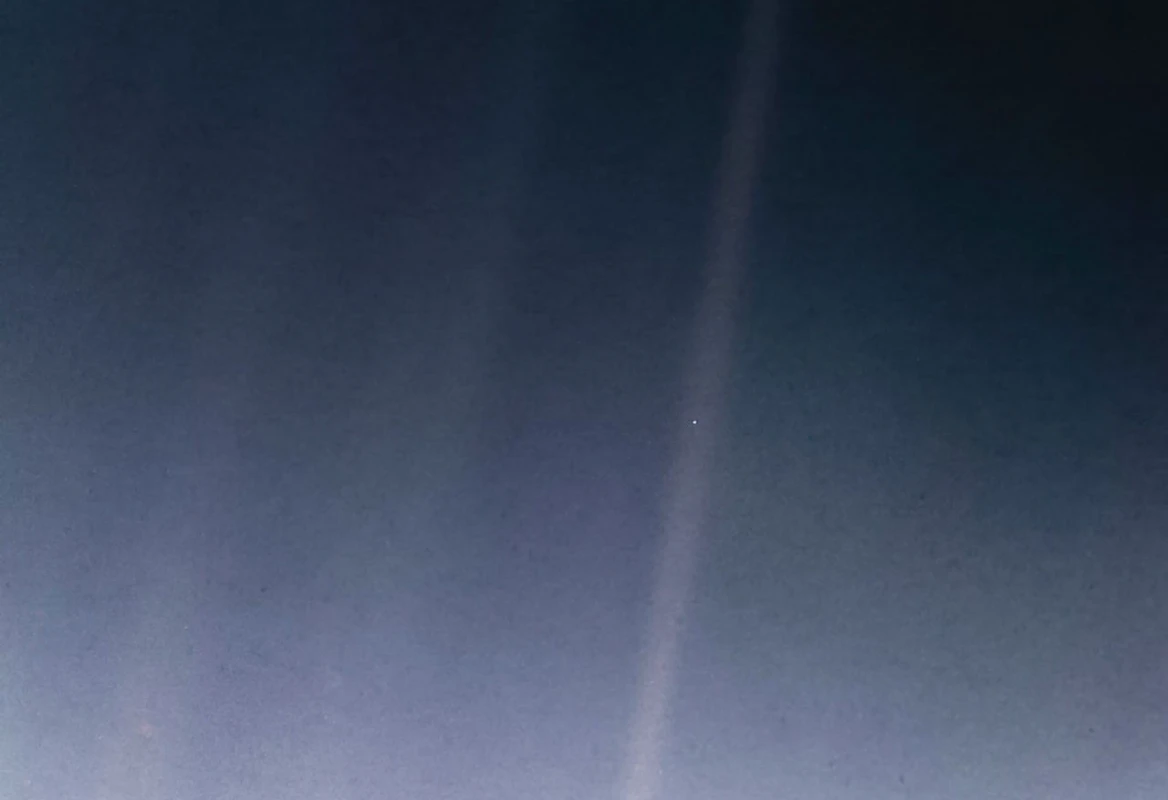
That tiny dot in space you saw in the picture above is our Earth.
This photo was taken by NASA’s Voyager 1 on February 14, 1990, from a distance of approximately 6 billion kilometers. It was Voyager’s one last look at home before continuing its journey into the unknown.
"Look again at that dot. That's here. That's home. That's us. On it everyone you love, everyone you know, everyone you ever heard of, every human being who ever was, lived out their lives. The aggregate of our joy and suffering, thousands of confident religions, ideologies, and economic doctrines, every hunter and forager, every hero and coward, every creator and destroyer of civilization, every king and peasant, every young couple in love, every mother and father, hopeful child, inventor and explorer, every teacher of morals, every corrupt politician, every "superstar," every "supreme leader," every saint and sinner in the history of our species lived there--on a mote of dust suspended in a sunbeam." — Carl Sagan, Pale Blue Dot, 1994
Space is unimaginably vast. A layperson’s mind can’t truly grasp how distance and time work out there. What remains is a haunting feeling, a sense of smallness and an instinctive urge to return home to the people we love.
Aren't we pretty lonely?
Even if we’re not alone in this universe and some intelligent species might exist somewhere in this massive galaxy; we can’t really rely on them. Let’s be a little optimistic and imagine that an alien civilization exists near our closest star, Proxima Centauri. Even then, light, which travels incredibly fast, takes about 4.25 years to reach from our Sun to theirs. To put that in perspective: the fastest human-made object so far is NASA’s Parker Solar Probe, which travels at around 687,000 km/h. That’s just about 0.064% the speed of light. Now, suppose by some miracle we manage to build a manned spacecraft that can travel at 1% the speed of light (roughly 10,800,000 km/h). Even then, it would take us around 425 years to reach Proxima Centauri (with very rough calculations, ignoring the laws of physics and practical limitations). And even if another civilization does cross paths with us someday, we won’t know whether they’ll sing for the laughter or they'll sing for the tear.
"Two possibilities exist: either we are alone in the Universe or we are not. Both are equally terrifying." — Arthur C. Clarke
Now, in a sense we are pretty lonely, right?
Actually no.
We have us — our people, our friends and family, those we love, and those who love us.
It doesn’t really matter that just 100 kilometers above us lies the vast blackness of space, a place with no air to breathe, nothing to touch, and no one to rely on. What truly matters is whether you’re sleeping peacefully at night. Whether you’re closing your eyes beside your loved ones before the weight of the cosmos reaches your thoughts. Whether you’re laughing with the people you cherish, and looking up at the stars not with fear, but with wonder.
Let this be a message from us to the cosmos: Love transcends space and time, everything that the human mind can't comprehend.
What we can comprehend is the importance of being humble, respectful, and joyful. Of treating others with kindness, and making our little blue home a place where love thrives.
Rama: It's time to go now.
Hardy: Soooo... it's a good bye then?
Rama: Yeah. It's been a good time. May we meet again in the future.
Hardy: But you understand this technology hasn’t been tested. The calculations might be off. You might never wake up if you go in there.
Rama: Even if I don't go in there, I’ll die of this disease. Anyways dying doesn’t matter to me, but maybe my life matters to them. I’ve lived a good life. From a child who failed physiology, to a—
Hardy: —to a world-renowned mathematician, and now a scientist. I’ve heard this story a thousand times. You’ve done more for humanity in the past few decades than has been done in centuries. You could’ve chosen anything else. I can think of a thousand things you could’ve done with that power of yours. Why this?
Rama: She told me to do it.
Hardy: I won’t ask you to change your decision. But can I ask you one last question, Rama? How did you do all this?
Rama: Can I be honest with you?
Hardy: Yeah.
Rama: I don’t know. I could just dream the numbers.
Rama: But you know what my favorite part was?
The smile on her face whenever I guessed the number she was thinking of.
Few links to explore:
Byee✨